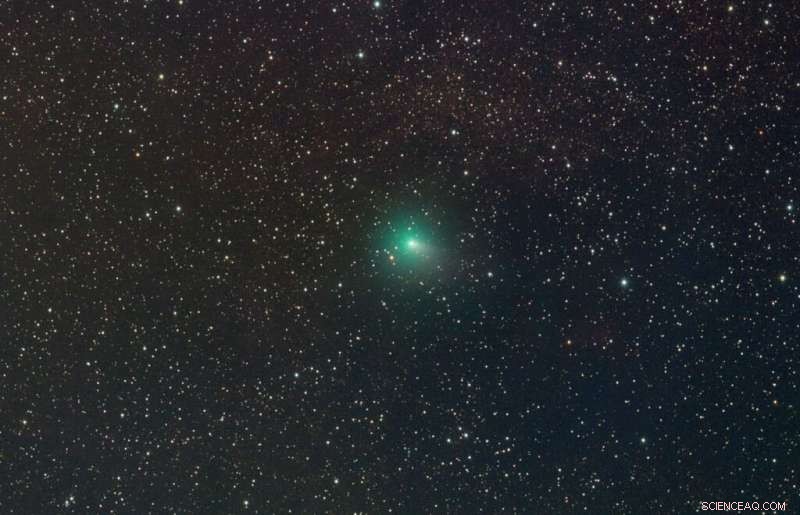
Comet C/2020 R4 ATLAS from April 11th, 2021. Credit: Michael Jäger
Looking to do some springtime astronomy? With temperatures warming up in the northern hemisphere in April through May, galaxy season is upon us. At dusk, the area in the Bowl of Virgo asterism rising in the east is rife with clusters of galaxies that spill over into the adjacent constellations of Coma Berenices and Boötes…
But this May, keep an eye out for a fuzzball interloper that is not a galaxy: Comet C/2020 R4 ATLAS.
Discovered on the night of September 12, 2020, by the prolific automated Asteroid Terrestrial Impact Last Alert System (ATLAS) sky survey based in Haleakala (ALTAS-HKO) and Mauna Loa (ATLAS-MLO) Hawaii, R4 ATLAS has proven to be an over-achiever. In fact, it was never initially predicted to top +10th magnitude… until a surprise outburst in late December 2020 shot it up 100-fold in brightness, from +18th to +13th magnitude. As of writing this, it sits at about +8th magnitude "with a bullet," and may top out +7th magnitude this week. Clearly, this is a dynamic comet with lots going on… and one more well-placed outburst this week could nudge it into naked eye territory.
The comet reached perihelion on its 957-year orbit on March 1st, 2021 at 1.029 Astronomical Units (AU)(95.7 million miles/154 million kilometers) from the Sun. Had the comet dropped by in August, its passage versus the Earth would have been four times closer.
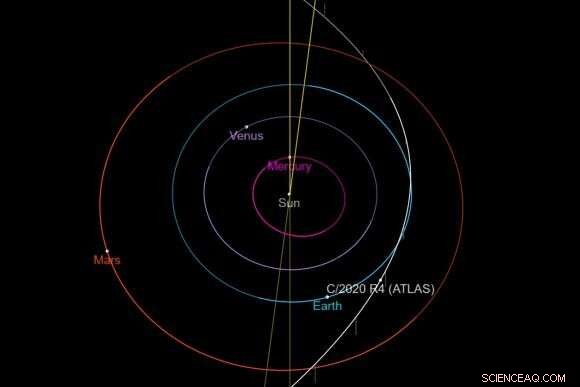
The path of comet C/2020 R4 ATLAS through the inner solar system. Credit: NASA/JPL
This once-a-millennium orbit also means that the comet last popped by in the mid-11th century, right around 1064 AD. Though R4 ATLAS—like most fainter comets of the pre-telescopic era—went unrecorded, another famous denizen of the solar system did make a historic appearance just a few years later: Comet 1/P Halley, in 1066 AD. Not only was this apparition of the most famous of all comets captured for posterity on the Bayeux Tapestry, but its appearance was around the same time as the death of Harold II during the Battle of Hastings and the ascendancy of William the Conqueror (a bad omen for Harold, but a good one for William).
The comet ends the month of April in the constellation of Hercules the Hero. Comet R4 ATLAS is now well placed for observation, ending April into early May high in the east in the "Spring Realm of the Galaxies' away from the plane of the Milky Way and the ecliptic plane at dusk, getting higher as the night goes on. Late May sees the comet high to the south at dusk.
Here's a brief list of "dates with celestial destiny" for the comet, month by month:
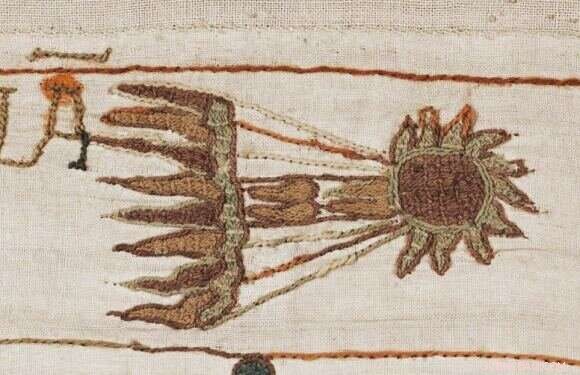
The Bayeux Tapestry, featuring Comet 1P Halley. Public Domain
April
May
June
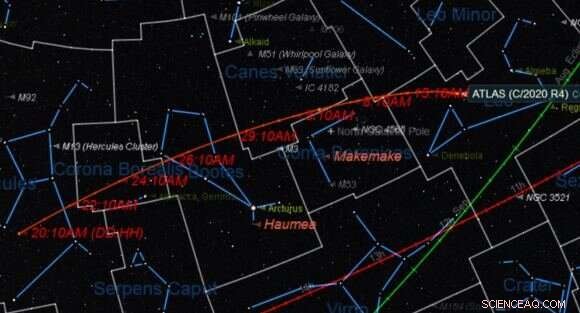
The celestial path of Comet C/2020 R4 ATLAS, from April 20th through June 1st. Credit: Starry Night/Dave Dickinson
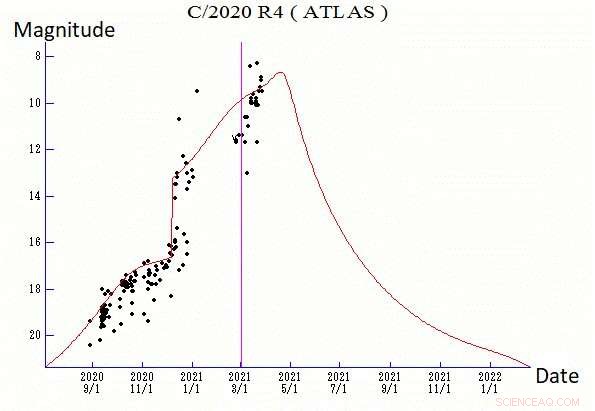
The brightness light curve of comet C/2020 R4 ATLAS. The black dots are based on actual observations. Credit: Adapted from Seiichi Yoshida’s Weekly Information About Bright Comets
Will R4 ATLAS brighten or fizzle? You just never know with comets. While +8th magnitude places R4 ATLAS in binocular territory, we've also got the waxing Moon reaching Full on April 27th to contend with. Hunt for R4 Atlas the way you would a moderately bright globular cluster… sweep the suspect field with binoculars or a telescopic wide-field of view, until a fuzzy patch becomes apparent. Unlike a globular cluster, however, a comet like R4 ATLAS will stubbornly refuse to resolve into individual stars upon focusing in. This contrasting comparison was one of 18th century comet hunter Charles Messier's legendary inspirations for drawing up his first catalog of deep-sky objects, as a way of marking the 'false comets' of the sky.
If skies are clear, be sure to check out Comet C/2020 R4 ATLAS, one of the first good comets of 2021.