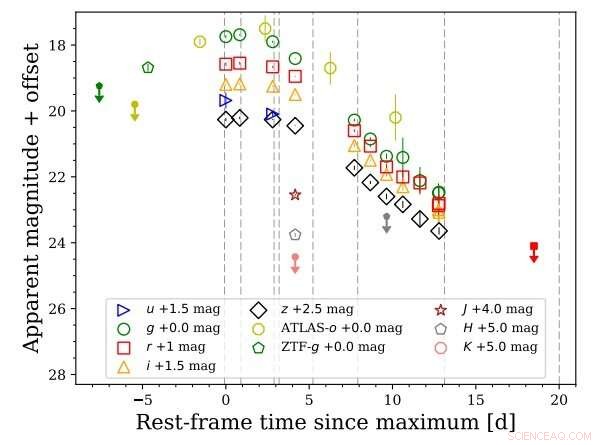
The multi-color light curves of SN 2019bkc from ZTF, ATLAS, LT, GROND, and NTT. Credit: Prentice et al., 2019.
An international team of astronomers has detected a new transient event as part of the ATLAS survey. The newly discovered transient, designated ATLAS19dqr/SN 2019bkc, turns out to be an extraordinary rapidly evolving calcium-rich event. The finding is detailed in a paper published September 12 on arXiv.org.
The so-called calcium-rich (Ca-rich) transients are the ones showcasing unusually strong calcium emission lines that develop in their spectra a few months after maximum. These events are usually located significantly offset (more than 32,000 light years) from their host galaxy centers.
The origin of calcium-rich transient is still debated, and many explanations have been presented to untangle the nature of these phenomena. For instance, it is assumed that such events could be triggered by a helium-shell detonation on the surface of white dwarf or tidal disruption and detonation of a white dwarf by an intermediate-mass black hole.
However, because of their faintness and fast evolution, the list of known calcium-rich transients is relatively short. Hence, finding new events of this type is of high importance to solve the remaining uncertainties about them.
In a recently published paper, a group of researchers led by Simon Prentice of the University of Dublin, Ireland, reports the finding of new calcium-rich transient using the Asteroid Terrestrial-impact Last Alert System (ALERT). They disclosed the presence of a rapidly evolving event isolated from any potential host.
"In this work, we presented the discovery, observations, and analysis of the extraordinary Ca-rich transient ATLAS19dqr/SN 2019bkc," the astronomers wrote in the paper.
ATLAS19dqr/SN 2019bkc was discovered in March 2019 at a redshift of about 0.02. It was observed in an intracluster space of a galaxy group. Given that pre-explosion images show no source underlying the transient, its connection with a faint host or globular cluster was ruled out.
According to the paper, the multi-color light curves of ATLAS19dqr/SN 2019bkc reached a peak at -17 mag about five to six days after it was detected. Shortly after, the source began a remarkably rapid decline by approximately 5.0 mag. Such behavior makes the event one of the most rapidly evolving transients known to date.
The early spectra of ATLAS19dqr/SN 2019bkc showcase similarities with Type Ic supernovae. However, later spectroscopic observations (over two weeks after the explosion) detected prominent calcium lines, which allowed the astronomers to classify the transient as a calcium-rich event.
"The nebular phase spectra display strong lines of [Ca II] λλ7291, 7324 and Ca II NIR but with a measured blueshift of 10,000—12,000 km/s," the paper reads.
The origin of ATLAS19dqr/SN 2019bkc remains unclear. In concluding remarks, the astronomers suggest that the progenitor of this event could be a massive star or white dwarf, taking into account the transient's low ejecta mass (most likely between 0.2 and 0.4 solar masses) and a low kinetic energy. More detailed modeling of the obtained spectra is required to identify the most plausible explosion scenario.
© 2019 Science X Network